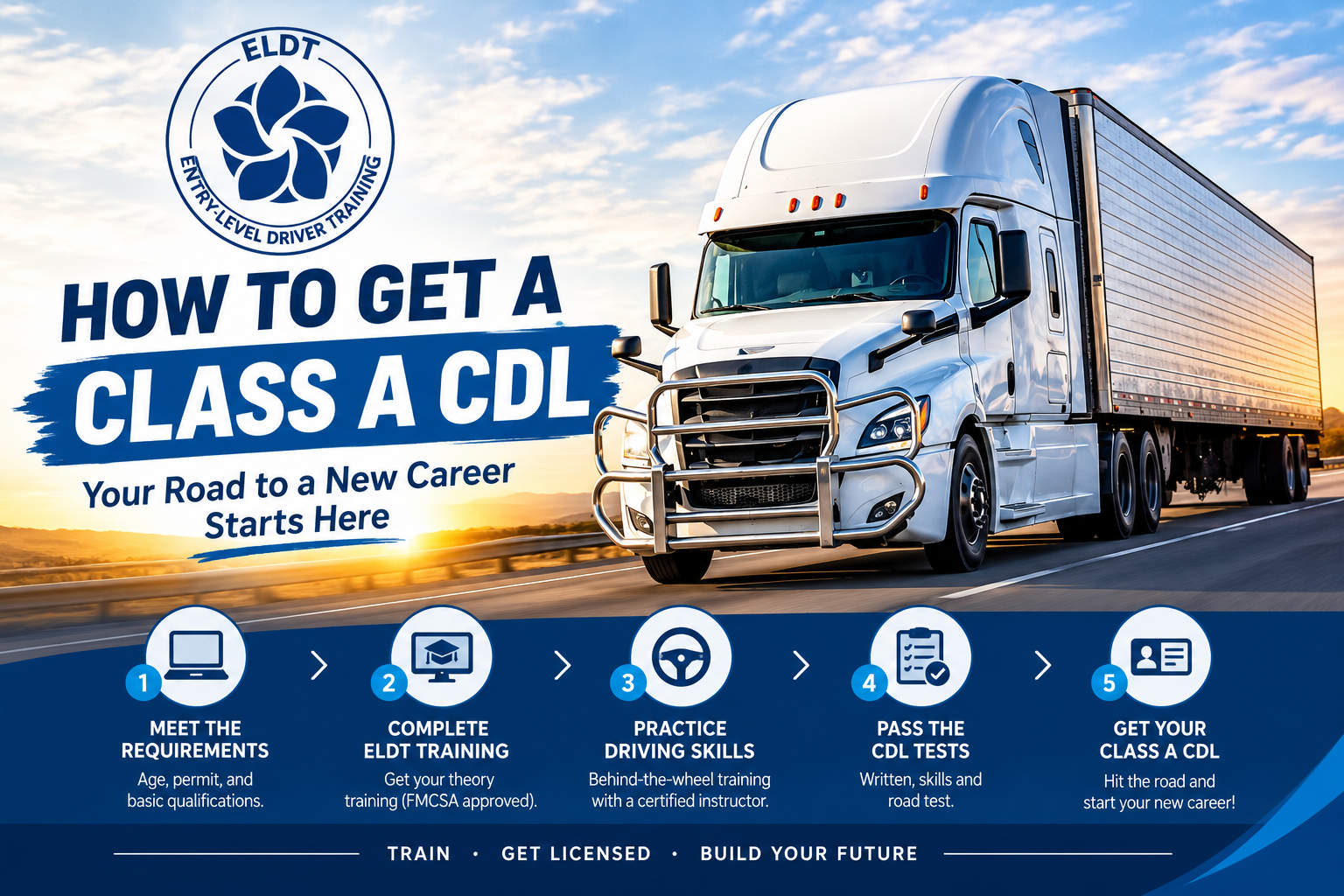
How to Get a Class A CDL?
Getting a Commercial Driver’s License (CDL) is an important step toward starting a career in the trucking industry. Class A CDL allows qualified drivers to operate certain combinations of commercial vehicles, including tractor-trailers and large trucks pulling heavy trailers and loads.
If you are planning to become a professional truck driver, understanding the licensing process can help you prepare for each step. From meeting eligibility requirements to completing Entry-Level Driver Training (ELDT) and passing your CDL tests, knowing what to expect makes the process easier to navigate.
In this guide, we explain how to get a Class A CDL, the training requirements you need to know, and how online ELDT theory training can help you prepare.
What Is Class A CDL?
A Class A Commercial Driver’s License is a commercial license that allows qualified drivers to operate combination vehicles with a Gross Combination Weight Rating (GCWR) of 26,001 pounds or more, provided the towed vehicle has a Gross Vehicle Weight Rating (GVWR) greater than 10,000 pounds.
Common vehicles associated with a Class A CDL include:
- Tractor-trailers and semi-trucks
- Truck and trailer combinations
- Livestock transportation trucks with qualifying trailers
- Flatbed trucks pulling qualifying trailers
- Tanker combinations, when the appropriate endorsements are obtained
The exact vehicles you can operate depend on your license classification, restrictions, and any required endorsements.
A Class A CDL can open opportunities in long-haul trucking, regional transportation, freight delivery, and other commercial driving fields.
Understand the Basic Eligibility Requirements
Before applying for a Class A CDL, make sure you understand the applicable federal and state requirements.
Generally, applicants need to:
- Meet the minimum age requirements for the type of commercial driving they intend to do.
- Hold a valid driver's license as required by their state.
- Meet applicable medical qualification requirements.
- Provide the required identity and residency documentation.
- Pass the applicable knowledge and skills tests.
- Complete required ELDT training before the relevant CDL skills test.
Drivers generally must be at least 18 years old to operate a commercial motor vehicle in qualifying intrastate commerce, subject to applicable rules. Drivers generally must be at least 21 to operate in interstate commerce, with limited exceptions under specific programs.
Requirements may differ depending on the state and the type of commercial driving involved. Check with your state driver's licensing agency for the requirements that apply to you.
Obtain a Commercial Learner's Permit (CLP)
A Commercial Learner's Permit allows you to practice driving a commercial motor vehicle under the applicable supervision requirements.
To obtain your CLP, you generally need to:
- Review your state's CDL application requirements.
- Gather the required identification and supporting documents.
- Meet applicable medical qualification requirements.
- Pass the required commercial knowledge tests.
- Apply through your state's commercial driver's licensing agency.
For Class A CLP, applicants commonly need to pass the general knowledge test and any other knowledge tests required for their intended vehicle or endorsements.
After obtaining your permit, you can begin or continue the required practical training under the applicable supervision rules.
Your state licensing agency can explain the testing process, fees, and documentation requirements.
Complete Required ELDT Theory Training.
Entry-Level Driver Training, commonly called ELDT, is a federal training requirement for certain new commercial drivers.
Under federal regulations, applicable individuals must complete ELDT before taking the CDL skills test for Class A or Class B CDL for the first time, among other qualifying situations.
ELDT generally applies to individuals who are:
- Obtaining a Class A CDL for the first time.
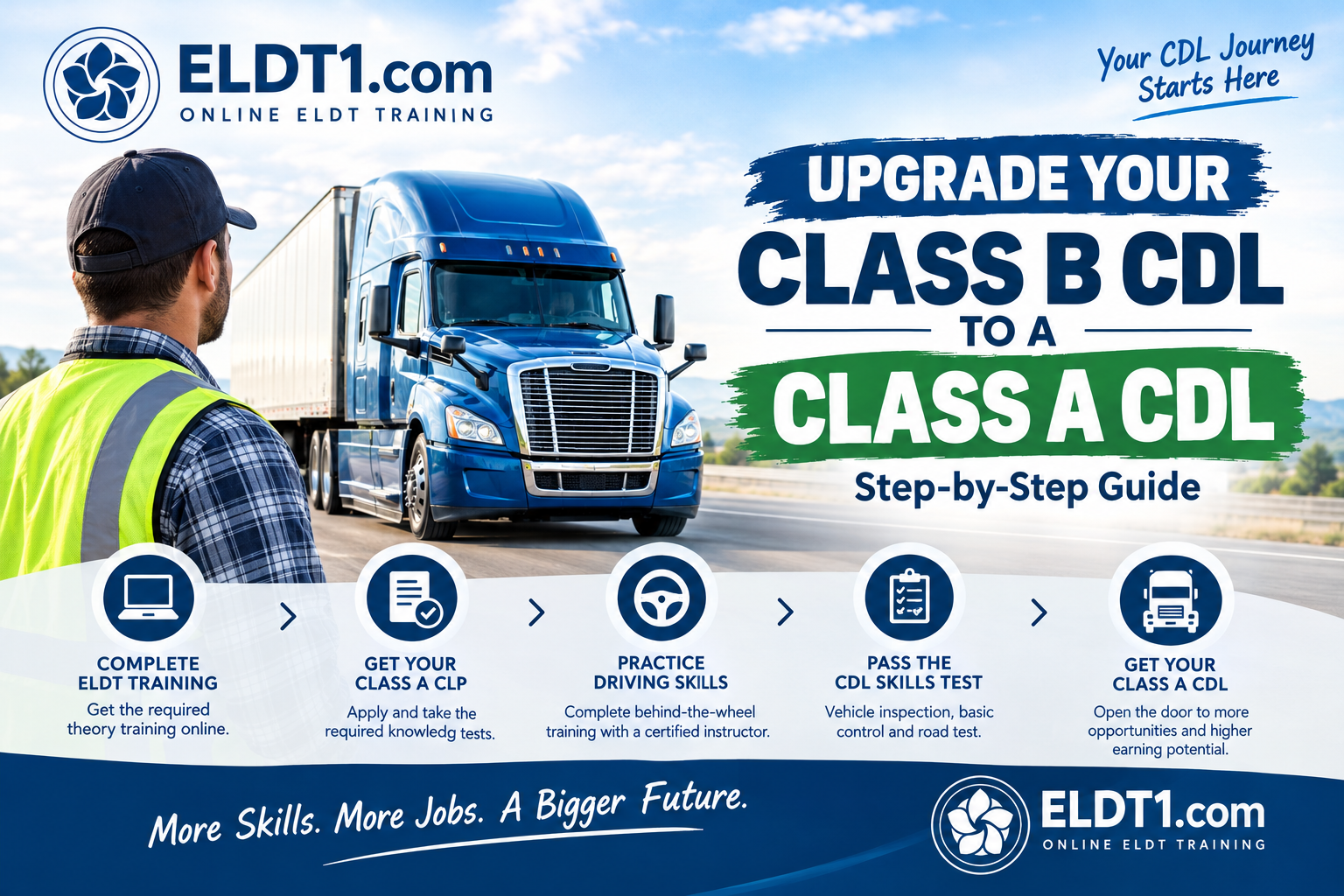
- Upgrading from a Class B CDL to a Class A CDL.
- Applying for a Class A or Class B CDL in another situation covered by the federal ELDT regulations.
Training must be provided by a training provider listed on the Federal Motor Carrier Safety Administration's Training Provider Registry (TPR).
Class A ELDT theory training covers important subjects such as:
- Basic operation of commercial motor vehicles
- Safe operating procedures
- Vehicle systems and controls
- Advanced operating practices
- Vehicle inspections and maintenance
- Safe driving practices
- Hazard perception and emergency procedures
Completing theory training helps you develop the knowledge needed for safe commercial driving. However, theory training does not replace the required behind-the-wheel training.
If you are looking for a convenient way to complete the theory portion of your training, ELDT1.com offers online ELDT training options. Review the available course details to find the option that matches your licensing needs.
Complete Behind-the-Wheel Training.
For Class A ELDT, completing theory training is only part of the process. Applicable students must also complete the required behind-the-wheel training with a registered training provider.
Behind-the-wheel training generally includes two components:
Range training
Range training helps students develop practical skills in a controlled environment. Depending on the curriculum, students may practice vehicle control, backing maneuvers, coupling and uncoupling, and other essential driving skills.
Public-road training
Public-road training gives students supervised experience operating a commercial vehicle in real traffic conditions. Students learn to manage vehicle space, turns, intersections, traffic, speed, and other situations that commercial drivers encounter.
Training must cover the applicable federal curriculum and meet the relevant requirements.
Online ELDT theory courses can help you prepare for the knowledge portion of your training, but they do not replace the practical instruction required for a Class A CDL.
Pass the CDL Skills Test
Once you have completed the required training and met your state's eligibility requirements, you can prepare to take the CDL skills test.
The CDL skills test generally includes three components:
1. Vehicle inspection
You demonstrate your knowledge of commercial vehicle safety inspections and explain how to identify important vehicle components and potential safety issues.
2. Basic vehicle control
You demonstrate your ability to control the vehicle during maneuvers such as backing and other exercises specified by the testing authority.
3. On-road driving
You demonstrate safe driving skills in traffic and follow the examiner's instructions while operating the commercial vehicle.
The testing authority may provide additional instructions about scheduling, test vehicles, documentation, fees, and any applicable state-specific requirements.
Practice regularly, review the material you learned during training, and make sure you understand the procedures you will be tested on.
Obtain Your Class A CDL
After passing the required tests and satisfying the applicable licensing requirements, you can complete the final steps with your state licensing agency.
Depending on your circumstances, this may involve submitting documentation, paying the applicable fees, and meeting any remaining requirements.
Your license may include restrictions based on the vehicle used for testing or other factors. Additional endorsements may also be necessary for types of commercial driving.
Before accepting a driving job, confirm that your CDL classification, endorsements, and restrictions match the vehicle and duties involved.
Common Mistakes to Avoid When Getting a Class A CDL
Preparing properly can help you avoid delays and unnecessary expenses.
1. Choosing an unregistered ELDT provider
If federal ELDT requirements apply to you, your training must be completed through a provider listed on the FMCSA Training Provider Registry. Verify the provider before enrolling.
2. Assuming online theory training is the entire process
Online theory training can be convenient, but Class A ELDT also requires applicable behind-the-wheel training. You must also satisfy the relevant licensing and testing requirements.
3. Studying only the night before an exam
Commercial driving knowledge covers many subjects. Study consistently, review difficult concepts, and use practice questions to identify areas that need improvement.
4. Ignoring state-specific requirements
Your state may have its own application procedures, documentation requirements, fees, and scheduling rules. Check official guidance before planning.
5. Overlooking license restrictions and endorsements
Passing your CDL test does not automatically qualify you to operate every commercial vehicle or transport every type of cargo. Make sure you understand the restrictions and endorsements that apply to your license.
Frequently Asked Questions About Class A CDL Training:
How long does it take to get Class A CDL?
The timeline varies depending on your state's procedures, permit preparation, training schedule, testing availability, and individual progress. Some applicants complete the process relatively quickly, while others need more time.
Do I need ELDT before getting Class A CDL?
If you are subject to the federal ELDT regulations, you must complete the required training before taking the applicable CDL skills test. Specific applicability rules and exemptions may apply.
Can I complete Class A ELDT theory training online?
Yes. Online theory training is an option when provided by an eligible training provider that meets federal requirements. Remember that required behind-the-wheel training must also be completed through an appropriate provider.
Can I get a Class A CDL without attending a traditional truck driving school?
Your options depend on the training arrangements available to you and the applicable regulations. You must complete all required theory and behind-the-wheel training through providers that satisfy the relevant requirements. Check the FMCSA Training Provider Registry and your state's licensing guidance before choosing a training path.
What is the difference between Class A and Class B CDL?
Class A CDL generally covers qualifying combination vehicles, while Class B CDL generally covers qualifying heavy single vehicles and certain combinations. The appropriate license depends on the vehicle's weight ratings and configuration.
Does completing ELDT guarantee that I will pass my CDL test?
No. ELDT helps you develop the required knowledge and skills, but you must still meet the applicable licensing requirements and pass the required tests.
Where can I verify ELDT training requirements?
You can review official information through the Federal Motor Carrier Safety Administration's Training Provider Registry at https://tpr.fmcsa.dot.gov/.
Start Preparing for Your Class A CDL Today
Getting a Class A CDL requires planning, preparation, and a clear understanding of the training and licensing process. From obtaining your commercial learner's permit to complete ELDT and passing the CDL skills test, each step helps prepare you for the responsibilities of commercial driving.
If you need to complete the theory portion of your training, explore the available online ELDT1.com and choose the option that fits your licensing goals.
Ready to take the next step towards your CDL? Visit ELDT1.com to learn more about available ELDT training options and start preparing for your commercial driving journey.
Disclaimer: This article provides general educational information and is not legal or licensing advice. Federal and state requirements may change. Always verify current requirements with FMCSA and your state commercial driver's licensing agency.